Executive Summary
Most dealerships are already running Google Search ads. The question isn’t whether to spend more—it’s whether you’re getting everything you can out of what you’re already spending.
Over the past several months (November 2025 through mid-March 2026), we were invited to test a new Google feature for the automotive industry called Vehicle Feeds on Search Ads, or VFSA, across a large breadth of dealerships at Dealer World. The results were consistent and statistically significant enough that we think every dealer should know about it.
This data has been shared and collaborated with our product and agency partners at Google.
Shoppers who have clicked these assets on responsive search ads are 15-25% more likely to convert. They’re not just more clicks; they’re better ones – all without interfering with your existing campaigns.
What VFSAs Actually Are
Right now, when someone searches for a vehicle, your Search ad may populate a headline that might say something like “Visit Our Ford Dealership.” By enabling VFSAs, that same ad can now also show a real photo of a series of specific vehicles, its price, and availability before the person even clicks.
VFSAs run on the same inventory feed system behind Vehicle Listing Ads, which many dealers already use. The difference is that it brings that inventory data into your standard Search ads, and it ONLY highlights your inventory – no fighting for digital real estate against competitive dealers or 3rd party listing sites.
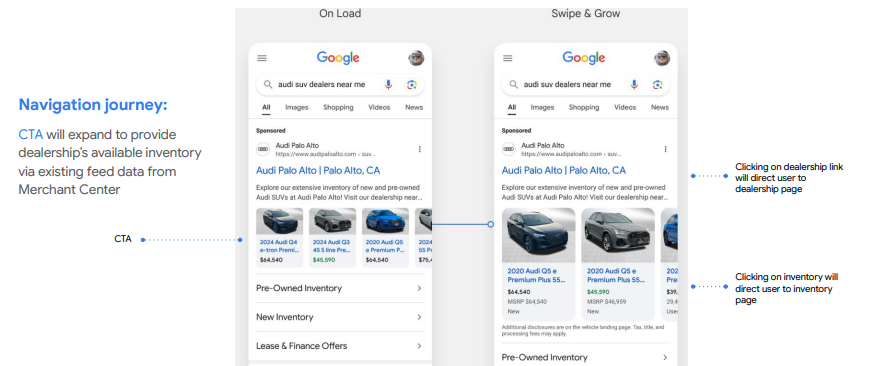
The practical effect: shoppers aren’t clicking on your dealership anymore; they’re clicking on a specific vehicle they’ve already seen and liked. That’s a fundamentally different kind of intent.
What the Data Shows
VFSA doesn’t flood you with more clicks. What it does is improve the quality of who’s clicking.
In our data, VFSA accounted for a relatively small share of total clicks (8.3% average) but a disproportionately large share of conversions. The people coming through these ads are further along in their decision. They’ve already seen a vehicle, a price, and a photo. By the time they hit your site, they’re not browsing; they’re closer to buying.
The 15-25% improvement in conversion rate held up across 92% of the dealerships analyzed over this 4 month period. It wasn’t a handful of outliers pulling the average. Double-digit efficiency gains were common.
One thing we specifically looked for: does turning this on hurt your existing ad performance? It doesn’t. Standard Search volume and lead flow stayed steady. VFSA added on top and didn’t cannibalize anything.
What This Means for Your Store/Group
If you’re already doing the fundamentals well — running an intent-centric Search strategy, managing your budget, keeping your inventory effectively marketed — then the next layer of improvement doesn’t come from a big strategic overhaul. It comes from small edges that compound over time.
VFSA is one of those edges. It moves shoppers closer to a decision before they ever arrive on your site. You might not feel it week to week, but over a quarter it shows up in your numbers.
What to Check
Getting value from VFSA comes down to a few basics:
Your inventory feed needs to be live, accurate, and current. Pricing, availability, and vehicle categorization all matter. Your photos need to be clean and high quality, since incomplete or low-quality listings underperform. Your Search campaigns need solid coverage across all key tiers of consumer intent search queries, and what you’re advertising should match what you have in stock, ideally without relying on Dynamic Vehicle Search Ads.
On the measurement side, look at Vehicle Asset clicks specifically, and track conversion rate rather than just click volume.
The Bottom Line
VFSAs aren’t a new silver bullet or a big swing. It’s a straightforward improvement to advertising you’re already running, should you have your fundamentals in a high performing state. Dealers who get set up correctly and keep their feeds clean will quietly get more out of every dollar they’re already spending, which, in this advertising and industry environment, is exactly the kind of advantage that matters.